

This article is about crossing the River Tyne. But SEP and the Sunderland Enterprise Park sit on the banks of the River Wear! However, as a Business Park, we have to acknowledge the importance to our region’s business life of that other great river, the River Tyne!
TT2 is adopting ‘cashless’ technology at the Tyne Tunnels (see Tyne Tunnels article) to facilitate moving around our region with ease. Therefore, we decided to take a brief look at the history of crossing these two great rivers.
Facts about the River Tyne
The North Tyne and South Tyne form the River Tyne. Eventually, these rivers converge at a place called ‘The Meeting of the Waters’ Warden Rock near Hexham, Northumberland.
It is 73 miles long and, of course, people have always needed to cross it. They have always done this by ferry or by bridge until the mid twentieth century when the Tyne Tunnels were built.
Ferry crossings
- The Shields Ferry Crossing (between North and South Shields) has existed at least since 1377.
- However, the ferry service as we know it now goes back to 1829 when the North Shields Ferry Company obtained a charter to operate on the Tyne.
- Sadly, it is the only Ferry Crossing which remains; the sole survivor of many services which had operated over the centuries.
Bridge crossings
It is not only crossing by ferry that goes way back in time! For centuries, people have also used bridge crossings.
Examples of historical bridge crossings
- Chesters Bridge has carried the Military Way since 122 AD.
- Corbridge Bridge dates back to 1674
- Chollerford Bridge has carried the Military Road since 1785.
Industrialisation and the advent of the railway
Subsequently, the increased industrialisation of Newcastle and the advent of the railways required increasing numbers of bridge crossings.
- High Level Bridge 1849
- Redheugh Bridge 1867. The current Bridge built in 1983 is the third Redheugh Bridge.
- Scotswood Rail Bridge 1871
- Scotswood Road Bridge 19649
- Swing Bridge 1876
- King Edward Rail Bridge 1906
The Tyne Bridge 1928

The Tyne Bridge
There has been a Tyne Bridge in Newcastle since Norman times. However, the wooden structure burnt down in 1248. It was rebuilt in stone in 1250. Finally, in 1771, it succumbed to centuries of battering by flood water and was replaced by the hydraulic Swing Bridge. Subsequently, the plans for a new Tyne Bridge were finalised and it eventually opened in 1928.
The Gateshead Millennium Bridge 2001
The River Tyne has many iconic bridge crossings and the Gateshead Millennium Bridge is the latest! It was the world’s first tilting bridge! It is the River Tyne’s only foot and cycle bridge taking its users from Gateshead’s artistic quarter home to The Baltic Centre for Contemporary Art and The Sage Gateshead to Newcastle’s historic quayside…or back the other way!

Gateshead Millennium bridge allowing pedestrians access to cross the River Tyne
The Tyne Tunnels crossings
- Tyne pedestrian and cyclist tunnel 1951
- First Tyne vehicle tunnel 1967
- Second Tyne vehicle tunnel 2011
Clearly, the Tyne Tunnels crossings are the new kids on the block! However, as we shall see, they too have had to adapt to changing work and lifestyles over their shorter history.
Pedestrian and Cyclists Tunnels
1947 – 1967
- As we have seen, before the Tunnels there were bridges and ferries to transport people across the river.
- By the 1930s these crossings could not cope with demand.
- 1947 – Construction began. Two shafts were sunk, one on each bank of the River.
- Miners excavated the connecting Tunnels.
- Work had to be done in a compressed air environment to stop the water coming in.
- Miners had to decompress at the end of their shift and some suffered from the bends.
- 1951 – the Tunnels were opened and formed part of the North East’s contribution to the Festival of Britain.
- Built at a cost of £833,000, as many as 20,000 people on cycles or on foot used the Tunnels to cross the River safely in order to work in the Tyne’s factories and shipyards.
- But a changing industrial profile and changing lifestyles, including increased car ownership, led to a decreasing number of users.
- Consequently, the first vehicle tunnel opened in 1967.
- However, these Tunnels were awarded grade II listed status in May 2000 to safeguard their future.
- In 2013 the Tunnels were closed for a complete refurbishment.
Refurbishment
2013 – 2019
- Harsh underground conditions and general wear and tear led to frequent breakdowns of escalators and lifts. Consequently, the cost of repairs spiralled. The high costs led to a poor state of repair.
- Finally, in 2013 the Tunnels were closed for a complete refurbishment. They re-opened once again in 2019. Once again, the Tunnels are a safe and reliable means of crossing the river.
Present day
The cyclist and pedestrian tunnels have approx. 15,000 users per month.
Vehicle Tunnels
- In the 1930s, the original scheme was proposed by Durham and Northumberland County Councils.
- However, the construction plans were put on hold because of World War II.
- 1946 – eventually the project was given the green light. Parliament passed the Tyne Tunnel Act 1946.
- Other options had been considered, such as a high-speed electric monorail or a very high bridge or an opening bridge.
- These options were rejected because of cost.
- After the war, funds were at a premium. It was decided to prioritise the cyclist and pedestrian Tunnels.
- The vehicle tunnel is much more expensive. At this time, cars were still a luxury especially for those working in industries.
- Eventually as cars become part of every day life the need for a vehicle tunnel becomes more pressing.
- Further, in the 1960s the region’s road network was being developed.
- October 1967 – The Queen opened the original vehicle tunnel.
- The A1 was routed through the tunnel until it was diverted to the Western bypass.
- Thereafter, the tunnel linked the A19.
The New Tyne Crossing project
The tunnel was well used and congestion was common. Consequently, it became clear that a second tunnel would relieve the congestion and open up the region’s economic prospects.

Northbound tunnel exit
Accordingly, in the 1990s, The New Tyne Crossing Project was developed. In 2011, the second vehicle tunnel was opened. It was finished ahead of schedule.
This allowed the first tunnel to close for refurbishment to modern day safety standards.

Northbound Tunnel Extractor Fans
TT2 is a private company. It has a 30 year contract (2037) to refurbish and maintain the Tunnels as a valuable route for commuters.
There has been a big uptake in users since the second tunnel opened. Traffic increased by 54%. In fact, in 2021, there are 50,000 users in a single day.
This means that the tunnels are a key transport link for the North East.
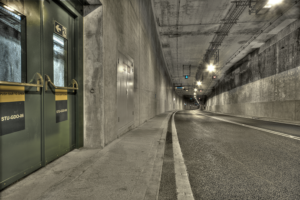
A rare sight for users of the tunnels – no traffic!
The only vehicle river crossing at the coast
In conclusion, the Shields Ferry is now restricted to carrying pedestrians. Therefore, the Tyne Tunnels represent the only vehicle river crossing at the coast.
Links for further reading
The Bridging Of The River Tyne
The Gateshead Millennium Bridge
How the famous Tyne Tunnels were built
Tyne Pedestrian and Cyclists Tunnels
The Tyne ferries which have carried thousands of passengers for generations